

CSIR - Centre for Cellular & Molecular Biology
The Innovation Engine of India
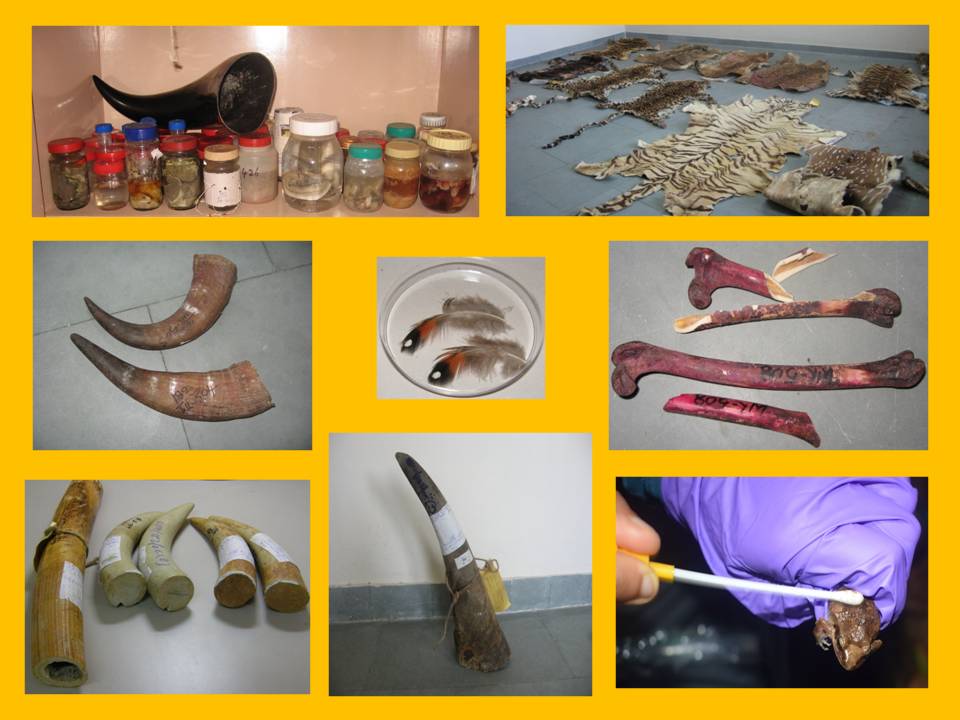
Wildlife DNA diagnostics bring awareness and speeds up reporting of crime involving poaching, illegal hunting and trade, thereby, speeding up justice process directly contributing to conservation of the endangered Indian species. Monitoring of illegal wildlife hunting and trade primarily requires species, individual and sex identification from parts and products seized at the checkpoints or crime scenes. CSIR-CCMB plays an important role in unambiguously identifying species involved in illegal wildlife trade by furnishing reports to law enforcement agencies. The DNA-based “Universal Primer” technology developed and patented by CCMB allows identification of a biological specimen of unknown origin and delineates its utility to the level of family, genus and species.
Address for sending samples for DNA analysis:
In-charge, Business Development Group,
iHUB, Medical Biotechnology Unit, CCMB Annexe II,
Near Genpact Campus, Uppal Road
Hyderabad – 500 039
Phone number: +40-27195512/27195523/27195555
Email: bdg[at]ccmb[dot]res[dot]in
Charges on Diagnostic Services
| S. No. | Service | Cost (Rs.) | Cost (Rs.) (Inclusive of 18% GST) | Pay now (To be done as for the genetic testing page) |
|---|---|---|---|---|
| 1. | Species identification per sample | 5,000.00 | 5,900.00 | |
| 2. | Paternity testing/relatedness/Individual identification | 12,000.00 | 14,160.00 | |
| 3. | Sexing of birds per sample | 1,500.00 | 1,770.00 | |
| 4. | Fertility (Progesterone/ Estradiol/Testosterone) including pregnancy detection and stress hormone (Cortisol) analysis in wild animals (for 10 samples) | 2,600.00 | 3,068.00 | |
| 5. | PCR based diagnosis (RTPCR) for RNA virus related diseases, per sample | 8,000.00 | 9,440.00 | |
| 6. | PCR based diagnosis for DNA virus related diseases, per sample | 4,000.00 | 4,720.00 | |
| 7. | Diagnosis of Bd in minimum 10 samples using nested PCR and qPCR | 3,600.00 | 4,248.00 | |
| 8. | Semen and Sperm profiling with chemical immobilization | 4,000.00 | 4,720.00 | |
| 9. | Semen and Sperm profiling without chemical immobilization | 3,000.00 | 3,540.00 | |
| 10. | Testing for Shahtoosh in woven products or fiber samples | 877.00 | 1,035.00 | |
| Pay now (To be done as for the genetic testing page) | https://www.onlinesbi.com/sbicollect/icollecthome.htm?corpID=378316 | |||
Once you make the payment please share the transaction details [e-Receipt] to bdg@ccmb.res.in or call 040 2719 5512 and inform.
Fees can also be paid in cash at the address mentioned above. This fee charged is a nominal amount towards the expenses on chemicals/reagents used for analysis. Fees once paid will not be refunded.
Frequently asked questions
Both fresh as well as dried tissue samples can be used for DNA extraction. It may include whole blood, blood stains, hairs, bones, meat flesh, skin pieces, feces/scat/stool, tooth pulp etc.
- Please note that CSIR-CCMB does not accept Ambergris (Whale Vomit), Animal oils/fats and Snake venom/poison (Liquid or crystals) for any type of DNA analysis.
- DNA techniques cannot be used for determining age and cause of death by poisoning or electrocution.
- Presently, sex identification and genotyping for individual identification and relatedness are only done for TIGER, LEOPARD and ELEPHANT, and not for other species.
- CSIR-CCMB does not conduct any analysis for detection of cause of death or age-determination.
It is essential for persons who collect biological samples to have some knowledge of DNA extraction and testing procedures so that he or she can take precautionary measures to ensure the integrity of DNA during collection.
Although small quantities of biological samples can yield sufficient DNA for profiling, it is always prudent to obtain as much forensic specimens as reasonable.
All relevant information, like type of specimen, date of collection, location and number, etc. must accompany each and every sample. Samples/exhibits not properly packed/sealed with official stamp/seal and forwarding letter will not be accepted for DNA analysis.
Note: Please do not use FORMALIN for preserving and storing the sample.
To minimize loss of quantity and quality of DNA, it is necessary to properly store the samples after collection. Sometimes the quantity of forensic specimen is small and limited and cannot be collected a second time. These materials (Tissues/biopsies) should essentially be stored at low temperatures, as described, or fixed in a solution like normal saline (0.85% solution of sodium chloride), alcohol or covered completely with common salt. The biological material can then be transported at room temperature for short periods or low temperature (in dry ice) for long period transportation.
In case of fresh blood, 50-100 micro liter of EDTA (0.5M solution) should be added to 5-10 ml of blood as an anticoagulant at the time of collection with gentle mixing for five-ten (5-10) minutes. It is always better to use EDTA vacutainers (pre-coated with EDTA, commercially available) for collection of blood. Proper hygiene must be maintained while collecting the samples. Dry samples (Skin, hair, nail, tooth, feather, etc.) should be collected in clear envelopes to avoid any possible contamination. These packets should be kept either in a cool and dry place or in frozen condition.
Dung/fecal sample should be collected and stored in plastic bags / zip-lock bags containing silica gel for desiccation and to prevent the growth of microbes. Make sure to collect the outer layer from the dung/fecal sample without too much disturbance. Since the outer layer is in contact with the intestinal tract, so this contains the cells. The dung/fecal sample should not be touched with bare hands to avoid contamination. Try collecting dung/fecal sample, which is fresh to few days old. After collection the dung/fecal sample should be stored at 4°C.
Collection of biological evidence from bite-marks/ bite wounds – Tissue/ saliva collected from wounds on human or animal carcass – Always wear sterile gloves and face mask at the time of sample collection. Swab samples should be collected from victim’s body/ carcass prior to post-mortem or before any handling/ moving of body. Swab samples should be collected as soon as possible after death. Saliva of the predatory carnivore is expected to be deposited around and within wound areas. In order to minimise contamination with victim’s tissue, superficial areas around the wound should be swabbed first, and the swab packed in a clean Ziploc cover. Separate swabs can be used to collect tissue/ saliva from surface or deeper layers of the wound and packed separately. Do not add ethanol or silica gel to the sample within the cover. Label the cover with details about victim, location, date of collection. Store cover in a cool place and transport immediately to the laboratory. It is important that samples are collected fresh and reach the lab as soon as possible due to minute quantities and degradable nature of the samples. Requirements – Sterile cotton swabs, Sterile gloves, Ziploc covers, Permanent marker.
It all depends on the recovery of moderately good quality of DNA from such samples. It may be successful in some cases, which of course can be tried in our laboratory.
Any investigation officer (Only Government) can be a forwarding authority of the sample.
As such there is no strict and specific pro forma for the details of samples. However, the minimum information required for examination of a sample, such as information about the handling and storage condition of the sample, date of collection, signed forwarding letter etc. should accompany the samples sent for DNA analysis.
In such situation the case should be forwarded through the state or central forensic laboratory, following the regular norms of forwarding a case for forensic investigation. We will submit the report of examination to that particular laboratory, which may later be defended by the scientific representative of that laboratory.
DNA analysis report and case properties can be collected by a person duly authorized by the same forwarding authority. The person should possess valid identity proof.
After submission of the DNA analysis report, the forwarding authority should make arrangements to take back the case properties/samples within one month. The case properties/samples will be incinerated if not taken back within one month of report submission. The perishable/putrefied samples will be incinerated immediately upon completion of DNA analysis.